
How to Source MLCC Capacitors During AI Server Demand Growth
Introduction
The rapid growth of artificial intelligence (AI) and machine learning (ML) workloads has created unprecedented demand for high-performance computing hardware. AI servers, equipped with multiple high-power GPUs and ASICs, require sophisticated power delivery networks (PDN) to maintain signal integrity and system stability. At the heart of these power delivery networks are multilayer ceramic capacitors (MLCC), particularly high-capacitance models that provide local energy storage and high-frequency decoupling. As AI server production scales, procurement professionals face significant challenges in sourcing the required MLCC. This article provides a comprehensive guide to understanding AI server MLCC requirements and developing effective sourcing strategies.
Understanding AI Server MLCC Demand Drivers
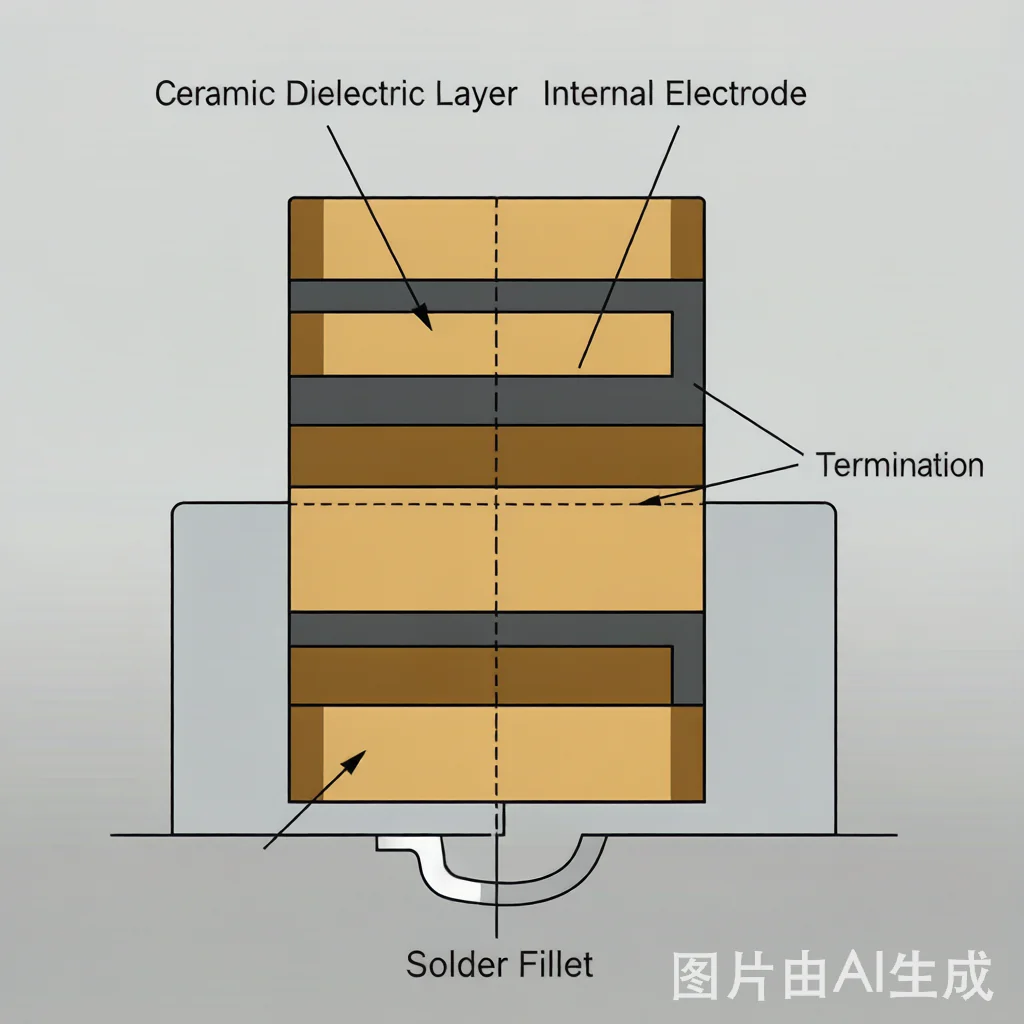
AI servers differ from traditional data center servers in their power requirements. A typical AI server may contain 4 to 8 high-end GPUs (such as NVIDIA H100 or A100), each drawing 300W to 700W of power. The power delivery network for these GPUs requires multiple voltage rails (core voltage, memory voltage, auxiliary voltages), each needing extensive decoupling capacitance. A single AI server motherboard can contain 500 to 2000 MLCC, with a significant portion being high-capacitance types (10µF to 100µF). The combination of high capacitance density, low equivalent series resistance (ESR), and low equivalent series inductance (ESL) makes MLCC indispensable for AI server power design.
- GPU core voltage rails (0.8V-1.2V) require 47µF-100µF MLCC in X6S or X7S dielectric
- Memory power rails (1.2V-1.8V) typically use 10µF-22µF MLCC in X7R or X6S
- Auxiliary power rails (3.3V-12V) may use 1µF-10µF MLCC for bulk decoupling
- High-speed serial interfaces (PCIe Gen5/6, NVLink) require low-ESL MLCC for signal integrity
Critical MLCC Parameters for AI Server Applications
Selecting the right MLCC for AI server applications requires careful consideration of multiple parameters. The dielectric type determines temperature stability and DC bias characteristics. X6S and X7S dielectrics are increasingly preferred over X7R for high-capacitance MLCC because they exhibit less capacitance loss under DC bias. For a 10µF/10V X6S MLCC in 0805 package, the effective capacitance at rated voltage may be 70-80% of nominal, compared to 40-60% for X7R. Package size affects both capacitance density and ESL. Smaller packages (0201, 0402) have lower ESL, which is critical for high-speed power delivery where parasitic inductance can cause voltage ripple and instability.
Package Size and ESL Considerations
For AI server applications, the trend is toward smaller package sizes for high-capacitance MLCC. While 1206 and 1210 packages offer higher capacitance values, their larger physical size results in higher ESL (typically 0.5-1.0 nH for 1206). In contrast, 0402 MLCC can achieve ESL as low as 0.2-0.3 nH. For GPU power rails operating at high switching frequencies (500kHz-2MHz), low ESL is essential to minimize voltage overshoot and undershoot during load transients. Many AI server designs now use multiple 0402 or 0201 MLCC in parallel to achieve the required bulk capacitance while maintaining low ESL. This approach also improves reliability by providing redundancy—if one MLCC fails, the impact on total capacitance is minimized.
Parameter Summary: AI Server MLCC Specifications
| Parameter | Typical Specification | Notes |
|---|---|---|
| Capacitance Range | 10µF - 100µF | Per power rail stage |
| Dielectric Type | X6S, X7S, X7R | X6S/X7S preferred for DC bias stability |
| Package Sizes | 0201, 0402, 0603, 0805 | Smaller sizes for lower ESL |
| Voltage Rating | 4V, 6.3V, 10V, 16V, 25V | Depends on power rail voltage |
| Temperature Range | -55°C to +105°C / +125°C | X6S: +105°C, X7R/X7S: +125°C |
| Tolerance | ±10%, ±20% | ±20% typical for high-capacitance |
| Example Part Numbers | GRM188R61A106KE69D (Murata, 10µF/10V/0603/X5R), CL21A106KPQNNNE (Samsung, 10µF/10V/0805/X5R), C0805C106K4RACAUTO (KEMET, 10µF/16V/0805/X7R) | |
Application Guidance for AI Server MLCC Sourcing
When sourcing MLCC for AI server projects, procurement professionals should adopt a multi-faceted strategy. First, identify the critical path MLCC—those with the highest capacitance values and most constrained supply. These typically include 47µF and 100µF MLCC in X6S/X7S dielectrics. Second, qualify alternative brands and part numbers early in the design phase. AIMLCC can assist with cross-reference evaluation, comparing electrical characteristics, package compatibility, and reliability data across brands. Third, consider forward-reserving capacity with suppliers or distributors. While AIMLCC is an independent sourcing platform and does not manufacture MLCC, we maintain extensive networks with suppliers worldwide to help secure allocation during shortage periods. Finally, monitor lead time trends and market intelligence. AI server demand cycles can be predicted to some extent by tracking GPU production schedules and data center capex announcements.
FAQ: AI Server MLCC Sourcing
Q1: Why are high-capacitance MLCC facing allocation during AI demand growth?
A: High-capacitance MLCC require more ceramic layers and precise manufacturing processes. The production capacity for these parts is not easily or quickly expanded. When AI server demand surged, GPU manufacturers secured large allocations from major MLCC brands, leaving limited capacity for other customers. This has created a supply-demand imbalance that is expected to persist through 2025-2026.
Q2: Can I use X7R instead of X6S for AI server power rails?
A: Yes, X7R can be used, but you must account for greater capacitance loss under DC bias. A 10µF X7R MLCC at rated voltage may provide only 4-5µF of effective capacitance, while an X6S part of the same nominal value may retain 7-8µF. For critical power rails, this difference can affect voltage ripple and system stability. Consult your power design engineer before substituting.
Q3: How can AIMLCC help with AI server MLCC shortages?
A: AIMLCC provides independent sourcing support, which means we are not bound by franchise agreements or allocation limits imposed by manufacturers. We can search across multiple suppliers, including those with excess inventory or short production runs. Additionally, we offer cross-reference services to identify alternative parts that may be more readily available. Our global supplier network enables us to source MLCC that may be difficult to find through traditional distribution channels.
RFQ Checklist for AI Server MLCC
- Confirm part number(s) and brand preference (Murata, Samsung SEMCO, TDK, YAGEO, etc.)
- Specify required capacitance, voltage rating, dielectric type, and package size
- Indicate quantity requirements (initial build and forecast for next 3-6 months)
- State target price range (if applicable)
- Specify required delivery date or project timeline
- Indicate whether alternative brands or part numbers are acceptable
- Include any special requirements (AEC-Q200, soft termination, PPAP documentation)
How to Source AI Server MLCC Through AIMLCC
AIMLCC is an independent sourcing platform specializing in MLCC procurement for AI, automotive, and industrial electronics. To source AI server MLCC through AIMLCC, start by preparing your BOM or parts list with the required specifications. You can submit this via our BOM upload tool or RFQ form. Our team will perform a stock check across our supplier network, provide cross-reference suggestions if appropriate, and deliver a quotation typically within 24 hours. For urgent requirements, you can also contact us via WhatsApp for immediate assistance. AIMLCC's independent sourcing model allows us to be flexible and responsive during supply chain disruptions, helping you keep your AI server production on schedule.