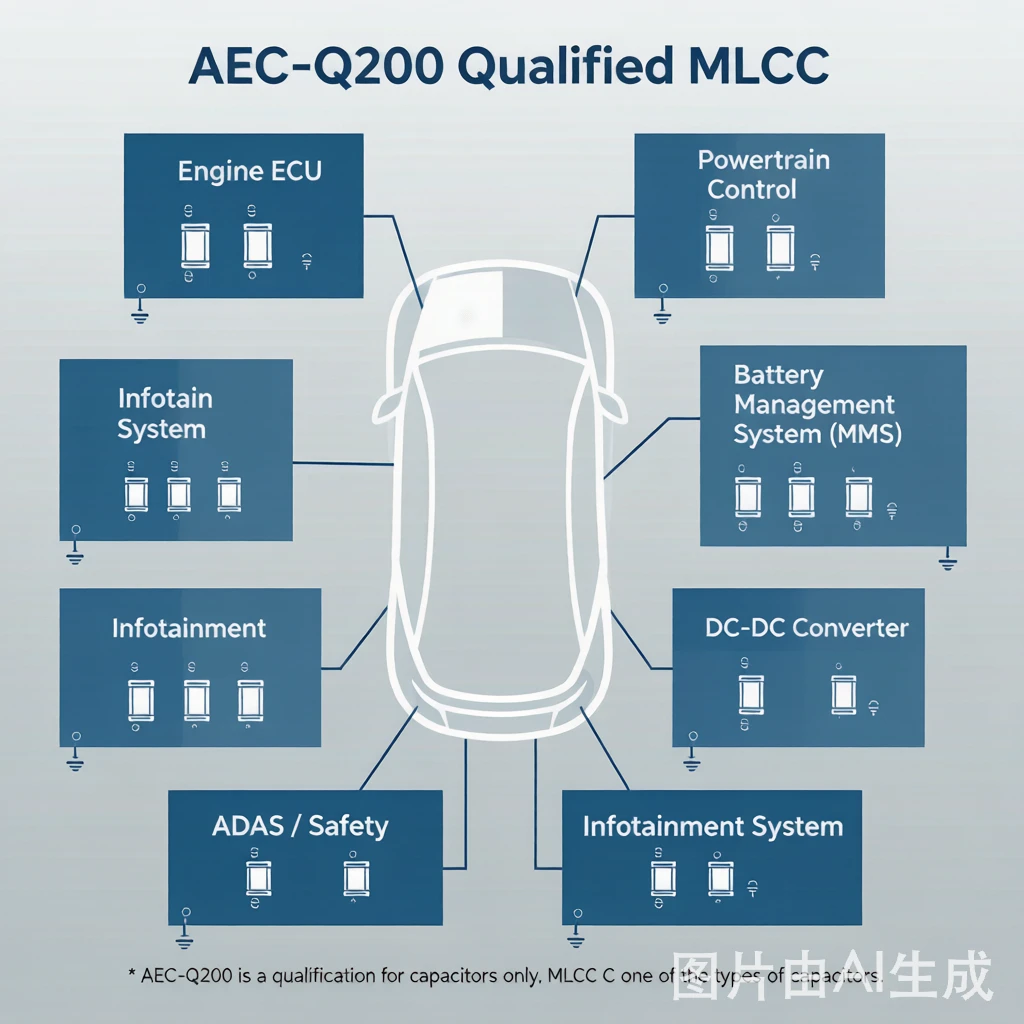
Automotive electronics operate in harsh environments with wide temperature swings, mechanical vibration, and stringent reliability requirements. The AEC-Q200 standard, developed by the Automotive Electronics Council, defines the stress test qualifications that passive components must pass to be used in automotive applications. Sourcing AEC-Q200 qualified MLCCs requires a systematic approach that goes beyond standard commercial-grade procurement, encompassing qualification verification, documentation requirements, and supply chain traceability.
AEC-Q200 is the qualification standard for passive components in automotive applications. It specifies a series of stress tests including temperature cycling, thermal shock, moisture resistance, mechanical shock, vibration, and biased humidity. MLCCs that pass these tests are designated as AEC-Q200 qualified and are suitable for use in automotive electronic control units (ECUs), battery management systems (BMS), ADAS sensors, motor controllers, and infotainment systems.
Not all MLCCs from a given manufacturer carry AEC-Q200 qualification. A specific part number may be available in both commercial and automotive grades, with the automotive version undergoing additional testing and traceability. When sourcing for automotive electronics or EV applications, it is essential to verify that the exact part number ordered is the AEC-Q200 qualified variant. Using a commercial-grade MLCC in an automotive application can lead to field failures and safety risks.
Automotive environments impose temperature requirements that exceed standard commercial specifications. The AEC-Q200 grade specifies the operating temperature range for the component, which must match or exceed the application requirement:
For EV battery management and motor controller applications, Grade 1 (-40C to +125C) is the typical requirement. X7R dielectric (rated to +125C) is the standard choice for Grade 1 applications, while X8L dielectric (rated to +150C) is used for Grade 0 applications in powertrain and engine compartment modules.
The dielectric choice for automotive MLCCs depends on the temperature range, capacitance requirement, and stability needs of the application:
For automotive power decoupling and bypass applications, automotive-grade MLCCs with X7R and X8L dielectrics are the standard choice. Browse AEC-Q200 MLCC products for qualified part options.
| Parameter | 0201 X7R | 0805 X6S | 1206 X8L | 0603 C0G |
|---|---|---|---|---|
| AEC-Q200 Grade | Grade 1 | Grade 2 | Grade 0 | Grade 1 |
| Temperature Range | -55C to +125C | -55C to +105C | -55C to +150C | -55C to +125C |
| Capacitance Range | 10pF to 1uF | 1nF to 10uF | 1nF to 10uF | 0.1pF to 220nF |
| Voltage Range | 6.3V to 50V | 10V to 50V | 10V to 100V | 16V to 100V |
| Capacitance Tolerance | plus or minus 10% | plus or minus 10% | plus or minus 10% | plus or minus 5% |
| Typical Applications | ECU bypass | Power decoupling | Powertrain filtering | RF, timing |
| Automotive System | Case Size | Dielectric | Typical Capacitance | Key Requirement |
|---|---|---|---|---|
| EV BMS controller | 0805, 1206 | X7R, X8L | 0.1uF, 1uF | Grade 1, high temp |
| Motor inverter gate driver | 1206 | X8L | 1uF | Grade 0, 150C |
| ADAS radar module | 0201, 0402 | C0G | 100pF to 1nF | RF stability, AEC-Q200 |
| ECU power decoupling | 0805 | X6S | 0.1uF, 10uF | Grade 2, vibration |
| Battery cell balancing | 1206 | X7R | 1uF | Grade 1, long life |
| Infotainment audio | 0603 | X7R | 0.1uF | Grade 2, low noise |
The following automotive AEC-Q200 MLCC part numbers are available for sourcing inquiry. Click any part number to view detailed specifications:
For additional automotive MLCC options, visit the TDK, Murata, KEMET, YAGEO, Samsung SEMCO, and Fenghua brand pages, or upload your BOM for comprehensive automotive MLCC sourcing.
Submit your automotive MLCC requirements through the MLCC RFQ form for independent sourcing support. Use the cross-reference tool to find AEC-Q200 equivalent parts across TDK, Murata, KEMET, YAGEO, Samsung SEMCO, and Fenghua. For automotive power supply applications, also see MLCC for industrial power supplies.
A: No. Commercial-grade MLCCs do not undergo AEC-Q200 stress testing and may not survive the temperature cycling, thermal shock, vibration, and humidity conditions encountered in automotive environments. Using non-qualified parts in automotive applications creates safety and reliability risks. Always source the AEC-Q200 qualified variant of the part number, which may have a different suffix or series designation than the commercial equivalent.
A: PPAP (Production Part Approval Process) is an automotive industry standard documentation package that verifies a supplier can consistently produce parts meeting all engineering requirements. PPAP Level 3 is the most comprehensive and is typically required for new automotive programs. It includes part approval warrants, design records, process flow diagrams, control plans, and test results. When sourcing automotive MLCCs, specify PPAP requirements in the RFQ so that documentation can be arranged alongside the parts.
A: For EV BMS applications, X7R dielectric (rated to +125C) is the standard choice for Grade 1 automotive qualification. X7R provides good capacitance density and temperature stability for decoupling and filtering in BMS controllers. If the BMS module is located near the battery pack where temperatures can reach 150C, X8L dielectric (rated to +150C) may be required for Grade 0 qualification. For RF or timing circuits within the BMS, C0G (NP0) dielectric in AEC-Q200 qualified variants is used.
A: Check the manufacturer datasheet or product catalog for AEC-Q200 qualification marking. Some brands use specific series designations for automotive parts, such as Murata GCM and GRT series, or TDK CGA series. If the datasheet does not clearly state AEC-Q200 qualification, request confirmation through the RFQ process. Do not assume that a part is automotive-qualified based on electrical specifications alone, as the qualification involves mechanical and environmental testing beyond electrical parameters.
A: Fenghua offers AEC-Q200 qualified MLCCs that may be considered as alternative sources for automotive applications. When evaluating Fenghua or any new brand for automotive use, verify AEC-Q200 qualification documentation, request PPAP support availability, and conduct qualification testing per your internal automotive quality process. Cross-referencing with the MLCC cross-reference tool can help identify candidate equivalents, but full automotive qualification approval requires brand-specific validation. RFQ for current stock and qualification status.
AIMLCC will check current stock, lead time and alternatives based on your part numbers or BOM.

Quick RFQ