
Automotive Grade MLCC and AEC-Q200: What Buyers Should Check
Understanding AEC-Q200 Qualification
The Automotive Electronics Council (AEC) is a body formed by major automotive manufacturers and suppliers to establish standardized qualification requirements for automotive electronic components. AEC-Q200 specifically addresses passive components, including MLCC, resistors, inductors, and ferrites. For MLCC to be AEC-Q200 qualified, they must pass a series of stress tests that simulate the harsh operating conditions in automotive environments. These tests include temperature cycling (1000 cycles from -55°C to +125°C), high-temperature storage, humidity bias (1000 hours at 85°C/85% RH with bias), mechanical shock (1000G), vibration (20G), and electrostatic discharge (ESD) testing. Only MLCC that pass all tests with acceptable failure rates (typically 0 ppm for critical applications) earn the AEC-Q200 mark. Procurement professionals should always verify AEC-Q200 qualification when sourcing MLCC for automotive projects.
AEC-Q200 Test Requirements and Procedures
The AEC-Q200 qualification process is rigorous and comprehensive. It begins with component sampling—typically 77 pieces per lot for MLCC. The tests are conducted in sequences designed to accumulate stress, simulating real-world automotive operating profiles. For example, temperature cycling tests expose the MLCC to extreme thermal expansion and contraction, which can cause cracking in poorly designed parts. Humidity bias testing evaluates the MLCC's ability to withstand corrosive environments while under electrical stress. Mechanical shock and vibration tests ensure the MLCC can survive the physical stresses of vehicle operation, including potholes, off-road conditions, and engine vibration. ESD testing verifies that the MLCC can withstand electrostatic discharge events during manufacturing and handling. MLCC that pass all tests are assigned an AEC-Q200 part number and listed in the manufacturer's AEC-Q200 qualified products catalog. When sourcing, always request the AEC-Q200 qualification report or certificate from your supplier.
- Temperature Cycling: 1000 cycles, -55°C to +125°C (or +150°C for Grade 3)
- Humidity Bias: 1000 hours at 85°C, 85% RH, with rated voltage applied
- High-Temperature Storage: 1000 hours at maximum operating temperature
- Mechanical Shock: 1000G, 0.5ms pulse, 5 pulses per axis
- Vibration: 20G, 10Hz-2000Hz sweep, 4 hours per axis
- ESD: HBM 2000V, MM 200V (varies by MLCC type)
Soft Termination: Critical for Automotive Reliability
One of the most common failure modes for MLCC in automotive applications is cracking due to PCB flexure or thermal cycling stress. Standard MLCC use rigid terminations (typically nickel barrier with tin plating) that can transmit stress to the ceramic body, causing cracks. Soft termination MLCC address this by adding a conductive resin layer between the ceramic body and the nickel/tin termination. This resin layer absorbs stress, significantly improving the MLCC's resistance to board flexure and thermal cycling. For automotive applications where the PCB may experience flexure (such as in powertrain control modules mounted on engine vibration isolators), soft termination MLCC are strongly recommended. Many AEC-Q200 qualified MLCC series now offer soft termination options—look for series designations such as Murata's GCJ series, TDK's CGA series with soft termination, or Samsung's CLL series. When sourcing automotive MLCC, always confirm whether soft termination is required for your specific application area.
Temperature Grades and Automotive Application Zones
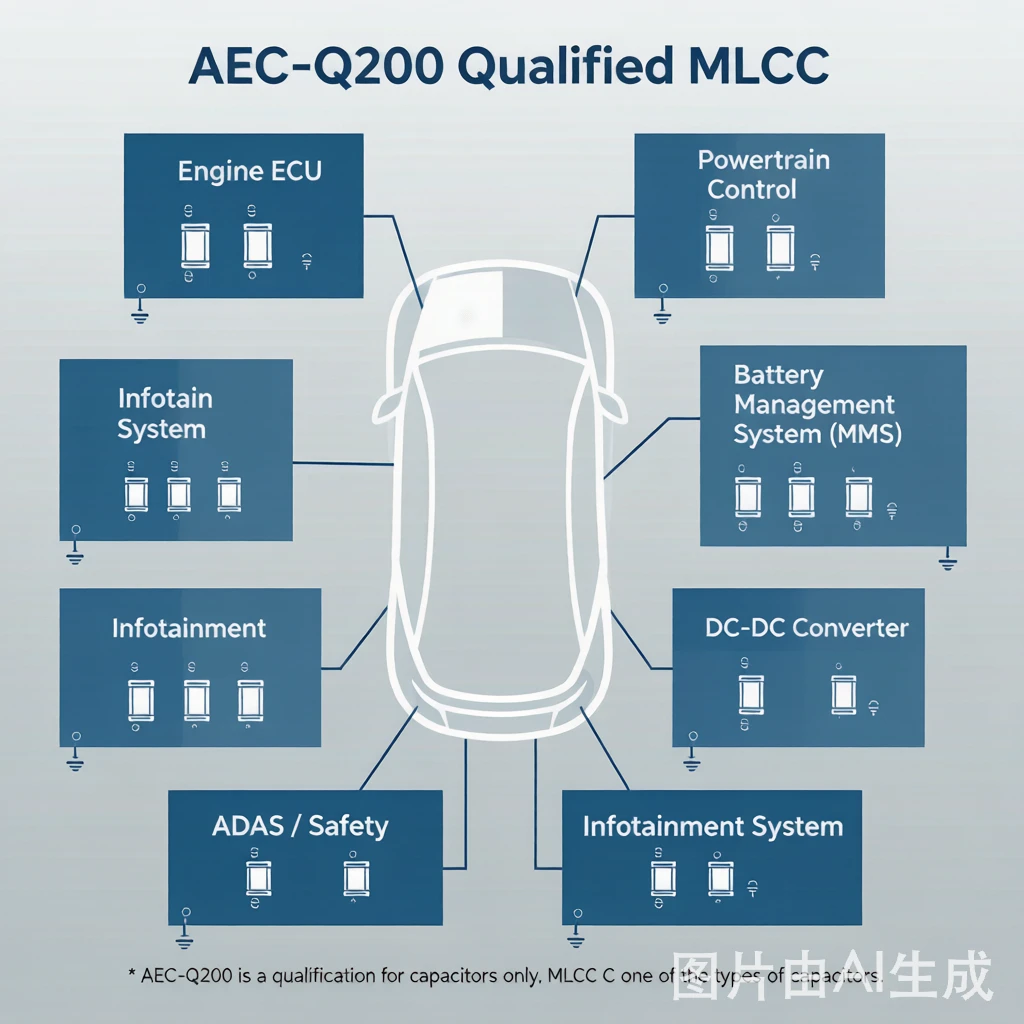
Automotive electronics operate across a wide temperature range depending on their location in the vehicle. Infotainment and cabin electronics typically operate from -40°C to +85°C (Consumer grade) or -40°C to +105°C (Grade 4 in some classifications). However, most automotive MLCC are specified for -55°C to +125°C (Grade 2) to provide margin. For under-hood applications (engine control units, transmission control, powertrain electronics), the temperature range extends to +150°C (Grade 3). In extreme cases, such as exhaust gas sensors or turbocharger electronics, temperatures can exceed +150°C, requiring even more specialized MLCC (though these are often custom or from limited sources). When specifying MLCC for automotive applications, always confirm the operating temperature range of the installation zone and select MLCC with appropriate margin. Using a 125°C rated MLCC in a 150°C zone will lead to premature failure.
Parameter Summary: Automotive Grade MLCC Specifications
| Parameter | Typical Specification | Automotive Requirement |
|---|---|---|
| Temperature Range | -55°C to +125°C (Grade 2) | -55°C to +150°C (Grade 3) for under-hood |
| AEC-Q200 | Qualified | Mandatory for automotive |
| Soft Termination | Optional (recommended) | Recommended for flexure-prone areas |
| Dielectric | X7R, X8R, X7S | X8R for +150°C, X7R for +125°C |
| Package Sizes | 0402 to 1812 | 0603+ preferred for reliability |
| PPAP Documentation | Level 3 or per customer | Required for production contracts |
| Example Series | Murata GRT series, TDK CGA series, Samsung CLL series, KEMET C-AEC series, YAGEO AC series | |
Application Guidance for Automotive MLCC Sourcing
Sourcing MLCC for automotive applications requires more than just checking the AEC-Q200 box. Procurement professionals should: (1) Verify the specific AEC-Q200 test report for the part number and lot. Counterfeit or misrepresented automotive parts are a known issue in the supply chain. (2) Confirm soft termination availability if the application involves PCB flexure risk. (3) Request PPAP (Production Part Approval Process) documentation if ordering for production. PPAP ensures that the supplier's manufacturing process is capable and under control. (4) Ensure lot traceability—automotive quality agreements typically require the ability to trace parts back to the manufacturing lot and date. (5) Consider single-sourcing risk. Automotive production contracts often span 5-10 years, requiring long-term supply commitments. Qualifying multiple sources (e.g., both Murata and Samsung for the same specification) mitigates supply risk. AIMLCC can assist with cross-referencing automotive MLCC across brands and verifying AEC-Q200 status.
FAQ: Automotive Grade MLCC and AEC-Q200
Q1: Is AEC-Q200 qualification mandatory for all automotive MLCC?
A: While not legally mandated, AEC-Q200 qualification is effectively mandatory for MLCC used in automotive applications. Major automotive OEMs and Tier 1 suppliers require AEC-Q200 compliance as part of their component qualification process. Using non-AEC-Q200 MLCC in automotive applications risks warranty claims, recall campaigns, and reputational damage. Always specify and source AEC-Q200 qualified MLCC for automotive projects.
Q2: What is the difference between AEC-Q200 and "automotive grade" labeling?
A: AEC-Q200 is a specific qualification standard with defined test procedures and acceptance criteria. "Automotive grade" is a marketing term that may or may not indicate full AEC-Q200 qualification. Always look for explicit AEC-Q200 marking on the part datasheet and packaging label. If in doubt, request the AEC-Q200 qualification certificate from the supplier. AIMLCC can assist with verifying AEC-Q200 status for sourced parts.
Q3: Can I use commercial grade MLCC in non-critical automotive applications?
A: This is generally not recommended. Even in "non-critical" applications such as interior lighting or basic infotainment, the automotive operating environment (temperature, vibration, humidity) exceeds commercial grade specifications. Additionally, automotive OEMs typically require full AEC-Q200 compliance across all electronic components in the vehicle. Using commercial grade parts risks failing OEM audits and quality reviews.
RFQ Checklist for Automotive Grade MLCC
- Confirm AEC-Q200 qualification (request certificate or test report)
- Specify temperature grade required (Grade 1, 2, or 3)
- Indicate if soft termination is required (recommended for most applications)
- Specify PPAP documentation level required (Level 1-5)
- Provide quantity requirements (annual_volume, batch size)
- Mention if lot traceability and COC (Certificate of Compliance) are needed
- Indicate production timeline and any long-term supply agreements
How to Source Automotive Grade MLCC Through AIMLCC
AIMLCC is an independent sourcing platform that supports procurement professionals in the automotive supply chain. We understand the rigorous requirements of automotive MLCC sourcing: AEC-Q200 qualification, PPAP documentation, lot traceability, and long-term supply stability. When you submit an RFQ for automotive MLCC, our team will verify the AEC-Q200 status of proposed parts, check soft termination availability, confirm documentation support, and provide cross-reference options to mitigate single-sourcing risk. For automotive production contracts, we recommend qualifying multiple sources—our global supplier network enables us to identify and evaluate alternative AEC-Q200 qualified MLCC that meet your technical and quality requirements. Submit your automotive MLCC requirement via our RFQ form or BOM upload tool to get a comprehensive sourcing proposal tailored to automotive industry standards.