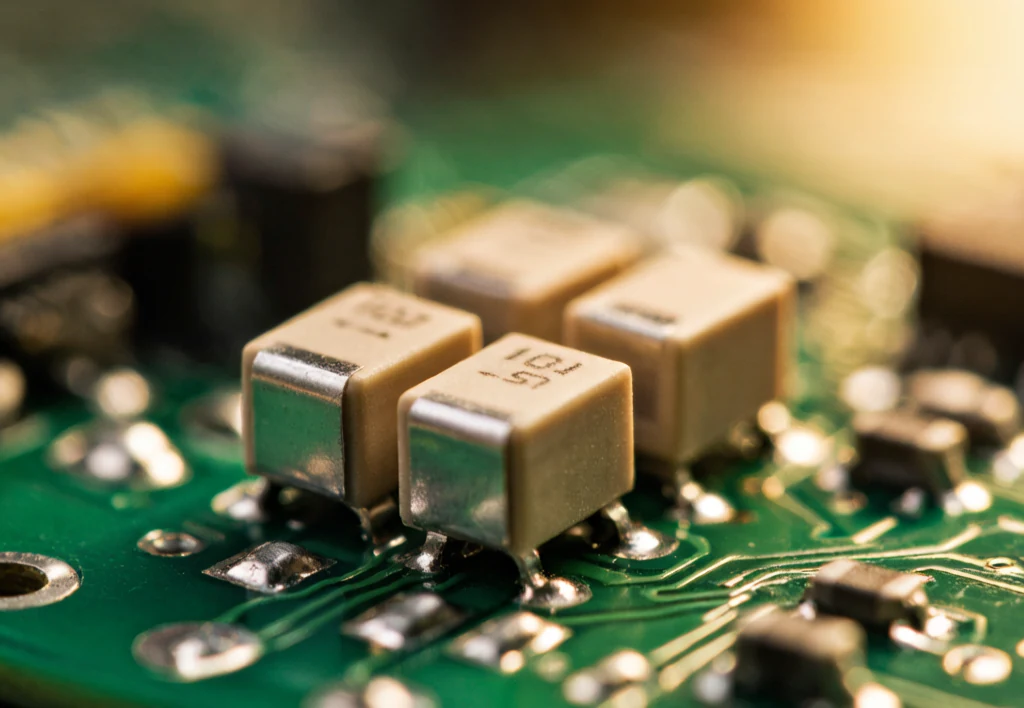
AI server architectures have fundamentally changed the requirements for board-level power decoupling. Modern GPU accelerators and AI inference ASICs draw transient currents that exceed 1000 amps on sub-1-volt rails, placing enormous demands on the bypass capacitor network. High-capacitance multilayer ceramic capacitors (MLCCs) in the 10uF to 100uF range are the primary components used to stabilize these power rails, and sourcing them in production volumes requires careful attention to dielectric characteristics, case size trade-offs, and DC bias behavior.
The core voltage rails on AI accelerators operate at very low voltages, typically 0.7V to 1.1V, but carry extremely high current. The voltage regulator module (VRM) that feeds each rail must maintain tight regulation under fast load transients. When the GPU transitions from idle to full compute load in microseconds, the power rail voltage can droop if the local decoupling network cannot supply current instantly. High-capacitance MLCCs placed close to the power pins act as local energy reservoirs, bridging the gap until the VRM inductor current ramps up.
The trend toward higher compute density in AI server platforms means that the available board area for decoupling capacitors is shrinking while the required total capacitance is increasing. This drives demand for the highest capacitance values available in the smallest possible case sizes. A single AI accelerator board may use several hundred high-capacitance MLCCs across its power distribution network.
High-capacitance MLCCs rely on Class II and Class III ferroelectric dielectric materials. The dielectric choice directly affects the maximum achievable capacitance, temperature stability, and voltage derating behavior:
For data center applications, X6S and X8L dielectrics are becoming the preferred choice because they combine high capacitance density with temperature ranges that accommodate the elevated ambient temperatures inside densely packed server chassis.
One of the most important parameters to understand when sourcing high-capacitance MLCCs is the DC bias effect. Class II and Class III dielectric materials are ferroelectric, meaning their permittivity decreases when a DC voltage is applied across the capacitor. For a 10uF, 6.3V rated MLCC operated at 3.3V, the effective capacitance may drop to 50% or less of the nominal value. At the full rated voltage, the effective capacitance can be as low as 30% of nominal.
This derating has direct implications for AI server power rail design. If the effective capacitance is significantly lower than nominal, the transient response of the power delivery network may not meet the specification. Designers often mitigate this by selecting parts with higher voltage ratings, using larger case sizes, or placing multiple capacitors in parallel. When sourcing, always request the DC bias characteristic curve from the datasheet or through the RFQ process to confirm effective capacitance at the operating voltage.
The choice of case size involves trade-offs between capacitance density, voltage rating, board area, and parasitic inductance:
For AI server GPU core voltage rails, the typical strategy uses a combination of 0402 parts for high-frequency decoupling near the die, 0805 parts for mid-frequency bulk capacitance, and 1206 parts for lower frequency energy storage. This multi-tier approach optimizes impedance across the frequency spectrum.
| Parameter | 10uF / 0402 | 10uF / 0805 | 47uF / 1206 | 100uF / 0805 |
|---|---|---|---|---|
| Typical Voltage Rating | 16V to 25V | 6.3V to 25V | 6.3V to 10V | 6.3V |
| Common Dielectric | X5R | X5R, X6S | X8L, X7R | X7R |
| Temperature Range | -55C to +85C | -55C to +105C | -55C to +150C | -55C to +125C |
| DC Bias Derating at 50% Vr | 40% to 60% loss | 40% to 60% loss | 50% to 70% loss | 50% to 70% loss |
| Typical ESR (100kHz) | 5 to 15 mOhm | 3 to 10 mOhm | 2 to 8 mOhm | 2 to 6 mOhm |
| Board Area (mm squared) | 0.5 | 2.5 | 5.12 | 2.5 |
| Application | Typical Capacitance | Case Size | Dielectric | Voltage Rail |
|---|---|---|---|---|
| GPU core voltage decoupling | 10uF, 22uF | 0402, 0805 | X5R, X6S | 0.7V to 1.1V |
| Memory rail decoupling (HBM) | 10uF, 47uF | 0805, 1206 | X6S, X8L | 1.2V |
| VRM input bulk capacitance | 47uF, 100uF | 1206 | X7R, X8L | 12V, 48V |
| PCIe retimer power | 10uF | 0402 | X5R | 1.8V, 3.3V |
| NIC power rail filtering | 10uF, 22uF | 0805 | X5R, X6S | 1.0V, 1.8V |
| Board level bulk decoupling | 47uF, 100uF | 0805, 1206 | X7R, X8L | 3.3V, 5V |
The following high-capacitance MLCC part numbers from leading brands are available for sourcing inquiry. Click any part number to view detailed specifications:
For additional high-capacitance options, browse high-capacitance MLCC products or upload your BOM for a comprehensive sourcing quote.
Submit your requirements through the MLCC RFQ form to receive independent sourcing support for high-capacitance MLCCs. Use the cross-reference tool to find equivalent parts across brands.
A: The DC bias effect causes Class II and Class III dielectric MLCCs to lose effective capacitance when DC voltage is applied. A 10uF, 6.3V rated part operated at 3.3V may show 40% to 60% capacitance loss. This is normal behavior for high-capacitance MLCCs. Always check the DC bias characteristic curve in the datasheet and design for the effective capacitance at the operating voltage, not the nominal value.
A: For AI server environments where ambient temperatures near the GPU can exceed 85C, X6S (rated to 105C) or X8L (rated to 150C) are preferred over X5R (rated to 85C). X6S offers the best balance of capacitance density and temperature range for most server decoupling applications. X8L is chosen when higher temperature margins or maximum capacitance in 1206 case size are required.
A: Yes. Selecting a 25V rated part instead of a 6.3V rated part for a 3.3V rail will generally result in less DC bias derating because the operating voltage is a smaller percentage of the rated voltage. However, higher voltage parts in the same case size typically have lower nominal capacitance. The trade-off between voltage rating, effective capacitance, and case size should be evaluated per application.
A: Use the MLCC cross-reference tool and match case size, nominal capacitance, voltage rating, and dielectric type. Note that DC bias characteristics and temperature behavior may differ between brands even for nominally equivalent parts. Request datasheets or RFQ confirmation for critical parameters before approving alternatives.
A: Lead times for high-capacitance MLCCs vary significantly based on part number, quantity, dielectric, and market conditions. Some high-demand values for AI server applications may have extended lead times. RFQ for current stock and lead time information. AIMLCC provides independent sourcing support to help identify available inventory across multiple supply channels.
AIMLCC will check current stock, lead time and alternatives based on your part numbers or BOM.

Quick RFQ