
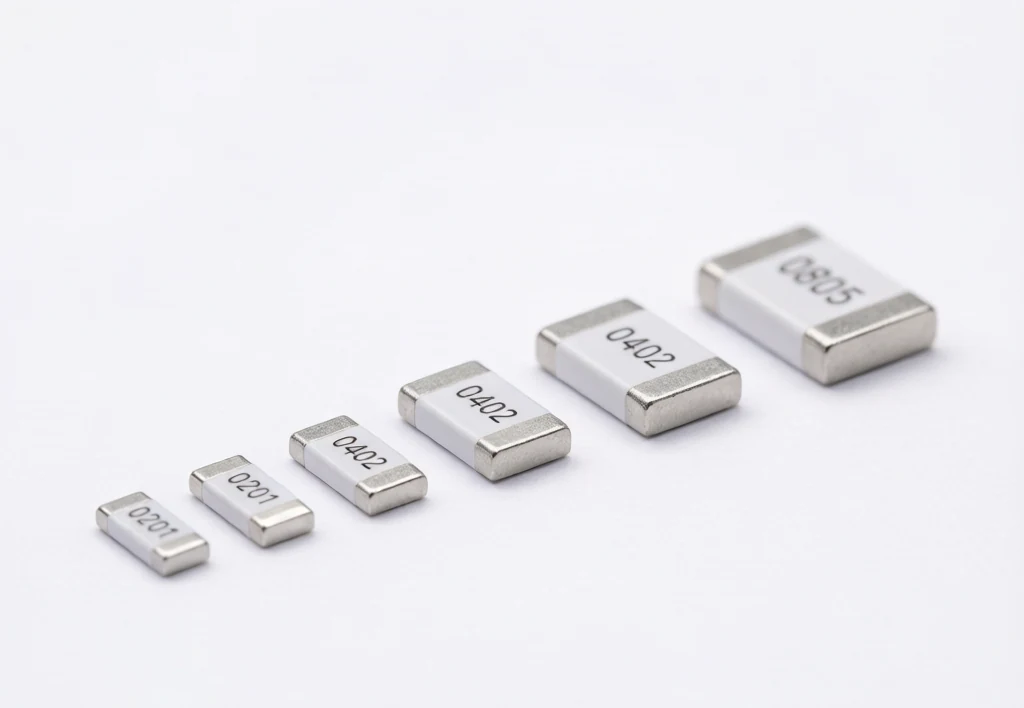
High Capacitance MLCC for Power Decoupling: 10µF, 47µF and 100µF
Why High-Capacitance MLCC Matter for Power Rails
Modern integrated circuits—particularly high-performance processors, GPUs, ASICs, and FPGAs—exhibit rapidly changing current demands during operation. When the load current shifts abruptly (such as when a CPU transitions from sleep to full processing state), the power delivery network (PDN) must respond instantly to maintain voltage regulation. The parasitic inductance of the PDN (from the voltage regulator, PCB traces, and vias) creates a time delay in the response, leading to momentary voltage droop or overshoot. High-capacitance MLCC placed close to the power pins of the IC act as local energy reservoirs, supplying the transient current during the brief interval before the regulator adjusts. Without adequate decoupling capacitance, voltage ripple can exceed IC specifications, causing timing errors, increased jitter, or even functional failure.
Understanding DC Bias Effect on High-Capacitance MLCC
One of the most critical yet often misunderstood aspects of high-capacitance MLCC is the DC bias effect. Class 2 dielectric materials (X5R, X7R, X6S, X7S) exhibit a phenomenon where the dielectric constant decreases when a DC voltage is applied. This results in the effective capacitance being significantly lower than the nominal (rated) capacitance when the capacitor is operating under bias. For example, a 10µF 10V X7R MLCC in 0603 package may measure close to 10µF at 0V DC, but only 3-4µF when 10V DC is applied. The effect is more pronounced for higher capacitance values and smaller package sizes, as these use thinner dielectric layers and experience higher electric field strength. When sourcing high-capacitance MLCC, always request the DC bias characteristic curve from the supplier and calculate the effective capacitance at your operating voltage.
- For 10µF MLCC at rated voltage: expect 30-50% of nominal capacitance remaining (X7R)
- For X6S/X7S MLCC: expect 60-80% of nominal capacitance remaining at rated voltage
- DC bias effect is negligible for C0G (NP0) dielectric—capacitance stays constant
- Always derate voltage (use 50-70% of rated voltage) to retain more capacitance
Dielectric Selection for High-Capacitance MLCC
While X7R has been the traditional choice for high-capacitance MLCC, newer dielectric formulations such as X6S and X7S are gaining popularity due to their improved DC bias characteristics. X6S operates over a -55°C to +105°C temperature range with ±15% capacitance variation, similar to X7R, but retains significantly more capacitance under DC bias. X7S extends the temperature range to +125°C with ±22% variation, while still offering better DC bias performance than X7R. For AI server and GPU applications where every microfarad of effective capacitance counts, specifying X6S or X7S can reduce the total number of MLCC required, saving PCB space and assembly cost. However, X6S and X7S may have longer lead times or limited availability compared to X7R. AIMLCC can assist with cross-referencing X7R designs to X6S/X7S and evaluating the trade-offs in cost and availability.
Capacitance Values and Package Size Relationships
The maximum capacitance available in a given package size is determined by the physical volume and the dielectric formulation. As a general guideline: 0603 package can accommodate up to 10µF (X7R, 6.3V) or 22µF (X6S, 6.3V in some advanced formulations); 0805 can reach 47µF; and 1206 can achieve 100µF. These are approximate maximums—actual availability depends on the manufacturer and specific series. For AI server GPU power rails requiring 100µF total decoupling per rail, designers may use a combination of: one 100µF 1206 MLCC (providing bulk capacitance), several 22µF 0805 MLCC (for mid-frequency decoupling), and multiple 0.1µF-1µF 0402/0603 MLCC (for high-frequency decoupling). This multi-tiered approach optimizes both space and performance.
Parameter Summary: High-Capacitance MLCC Specifications
| Capacitance | Typical Package | Voltage Rating | Recommended Dielectric | Example Part Number |
|---|---|---|---|---|
| 10µF | 0603, 0805 | 6.3V, 10V, 16V | X7R, X6S | GRM188R61A106KE69D (Murata, 10µF/10V/0603/X5R) |
| 22µF | 0805, 1206 | 6.3V, 10V, 16V | X7R, X6S, X7S | CL21A226KQNNNWE (Samsung, 22µF/6.3V/0805/X5R) |
| 47µF | 0805, 1206 | 6.3V, 10V | X6S, X7S | GRM219R60J476ME15D (Murata, 47µF/6.3V/0805/X6S) |
| 100µF | 1206, 1210 | 4V, 6.3V | X6S, X7S | GRT31S7A106KE01L (Murata, 100µF/6.3V/1206/X6S/AEC-Q200) |
Application Guidance for High-Capacitance MLCC Sourcing
Sourcing high-capacitance MLCC requires careful attention to market dynamics. These parts are frequently subject to allocation during periods of high demand (such as the current AI server boom). To mitigate shortage risk: (1) Qualify multiple brands and part numbers early in the design phase. AIMLCC can provide cross-reference suggestions to identify alternative sources. (2) Consider voltage derating not just for reliability, but also to retain more effective capacitance. A 10µF 16V MLCC used at 8V will retain more capacitance than a 10µF 10V part used at 8V. (3) Monitor lead time trends and place forward orders when possible. (4) For production builds, consider using a mix of capacitance values (e.g., 10µF + 22µF in parallel) to reduce dependency on a single hard-to-source part. AIMLCC's independent sourcing model allows us to tap into a broader supplier network than franchise-distributor channels, helping you secure allocation even during tight market conditions.
FAQ: High-Capacitance MLCC
Q1: How much capacitance do I need for my GPU power rail?
A: The required decoupling capacitance depends on the GPU's transient current demand, acceptable voltage ripple, and the PDN impedance profile. As a rough guideline, high-end GPUs may require 50-200µF of total decoupling capacitance per power rail, distributed across multiple MLCC in different package sizes. Consult your GPU datasheet and power design guidelines for specific recommendations.
Q2: Why do some high-capacitance MLCC have lower voltage ratings?
A: Higher capacitance requires more ceramic layers, which must be thinner to fit in the package. Thinner dielectric layers cannot withstand high voltages without risk of breakdown. Therefore, high-capacitance MLCC (47µF, 100µF) are typically available only in low voltage ratings (4V, 6.3V, 10V). For higher voltage applications, you must either use larger package sizes or multiple MLCC in series (though this reduces total capacitance).
Q3: Can AIMLCC provide high-capacitance MLCC that are on allocation?
A: AIMLCC is an independent sourcing platform, which means we are not subject to the same allocation restrictions as franchise distributors. We maintain relationships with a wide network of suppliers, including those with excess inventory or production overruns. While we cannot guarantee availability for allocated parts, our sourcing team has a track record of finding high-capacitance MLCC even during supply crunches. Submit your RFQ early and include alternative specifications to maximize the chance of success.
RFQ Checklist for High-Capacitance MLCC
- Target capacitance value (10µF, 22µF, 47µF, 100µF) and tolerance
- Voltage rating required (consider derating for more effective capacitance)
- Package size constraint (0603, 0805, 1206, or flexible)
- Dielectric preference (X7R, X6S, X7S) and temperature range
- Quantity needed (initial build and forecast)
- Alternative part numbers or brands that are acceptable
- Any AEC-Q200 or other quality certifications required
How to Source High-Capacitance MLCC Through AIMLCC
AIMLCC specializes in sourcing high-capacitance MLCC for demanding applications including AI servers, data centers, automotive powertrain, and industrial power supplies. Our RFQ process is designed to be fast and thorough: submit your requirement (part number or specifications), and our team will check stock across our global supplier network, provide DC bias guidance if needed, suggest cross-references to alternative brands or dielectrics, and deliver a quotation typically within 24 hours. For complex projects with multiple high-capacitance MLCC requirements, we recommend using our BOM upload tool to get a comprehensive stock check and optimization analysis. AIMLCC's independent sourcing model ensures you get objective recommendations based on technical fit and availability, helping you keep your production on schedule even when the market is tight.