
MLCC DC Bias Explained for High Capacitance Capacitors
What Is DC Bias in MLCC?
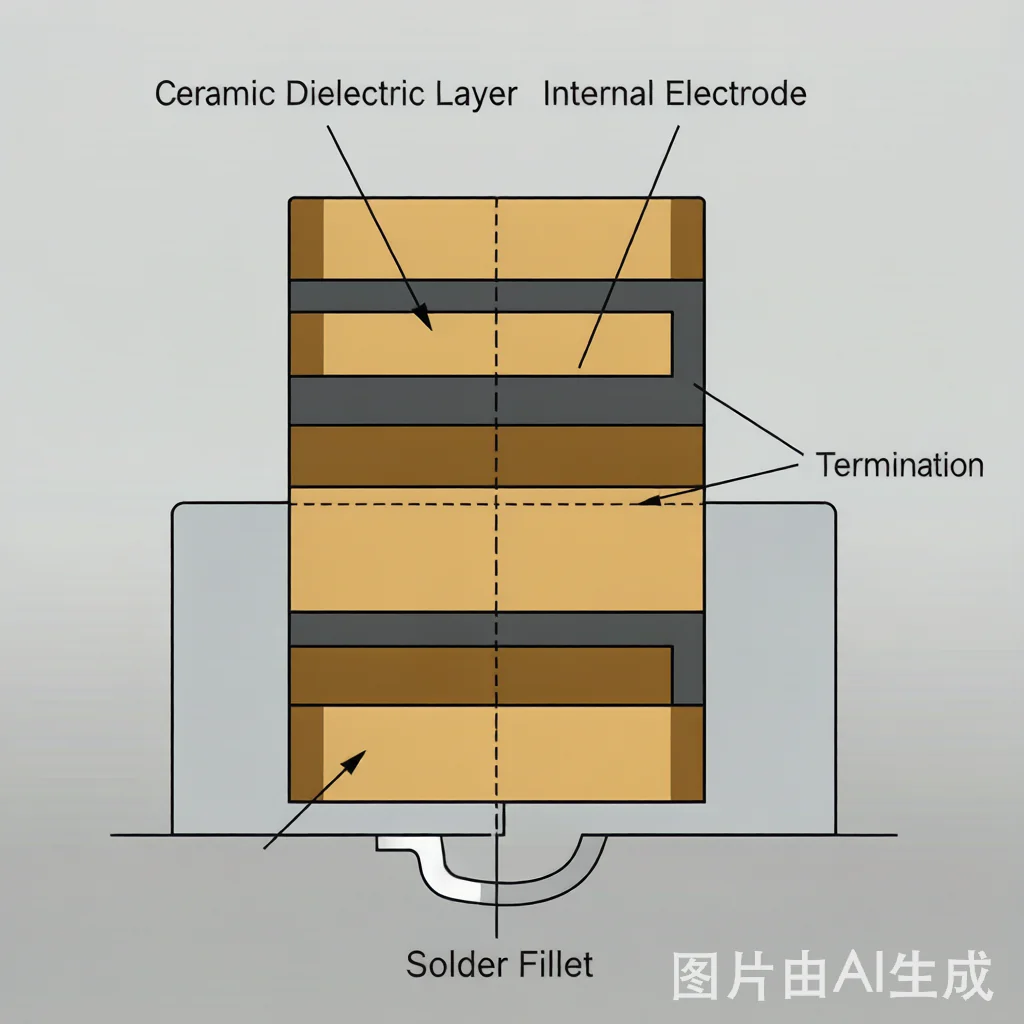
DC bias is the reduction of effective capacitance when a DC voltage is applied across an MLCC. It is a fundamental characteristic of Class 2 ceramic dielectrics. Under a DC field, the ferroelectric domains inside the barium titanate-based ceramic partially align with the field, lowering the effective dielectric constant and therefore the effective capacitance. The effect is reversible — removing the DC voltage restores the original value — but the loss is real while the part is in-circuit and must be accounted for.
For engineers and buyers working with high-capacitance MLCC (10uF to 100uF), DC bias is one of the most common sources of power-rail instability and one of the most overlooked specifications. A 10uF MLCC delivering only 4uF of effective capacitance under 6.3V bias can produce unacceptable ripple on a GPU core rail.
Why DC Bias Matters More at High Capacitance
Higher capacitance values require thinner dielectric layers stacked in greater numbers within the same physical package. Thinner layers see higher electric field strength at the same applied voltage, and Class 2 ceramics lose capacitance non-linearly with field strength. A 1uF 10V X7R in 0402 may retain 70-80% of nominal at rated voltage, a 47uF 10V X6S in 0805 may retain 60-70%, and a 100uF 6.3V X5R in 1206 may retain only 35-55%. Always request the full DC bias curve.
- 1uF 10V X7R 0402: 70-80% retention at rated bias
- 10uF 10V X7R 0805: 50-65% retention at rated bias
- 47uF 6.3V X6S 0805: 60-75% retention at rated bias
- 100uF 6.3V X5R 1206: 35-55% retention at rated bias
- C0G (NP0) any value: >99% retention at any bias within rating
Dielectric Comparison Under DC Bias
| Dielectric | DC Bias Sensitivity | Typical Retention at Rated V | Best For |
|---|---|---|---|
| C0G (NP0) | None | >99% | Timing, RF, precision circuits |
| X7R | High | 30-70% | General decoupling, filtering |
| X5R | High | 25-65% | High-C decoupling |
| X6S | Moderate | 45-80% | AI server, GPU power rails |
| X7S | Moderate-Low | 50-85% | High-density power decoupling |
How to Compensate for DC Bias in Your Design
If your 10uF MLCC delivers only 4.5uF at operating voltage, you need to compensate. The most common approaches are: selecting a higher nominal capacitance to hit the target effective value after derating; choosing a dielectric with better DC bias performance (X6S instead of X7R, X7S instead of X6S); increasing the package size from 0603 to 0805 or 1206 for the same nominal value; or adding more capacitors in parallel to meet the total effective capacitance requirement. A good practice is to define your BOM by effective capacitance at working voltage, not by nominal value. For example, specify "10uF effective at 5V DC bias" rather than "10uF 10V X7R."
FAQ
Q: Does DC bias affect C0G (NP0) MLCC?
A: No. C0G (NP0) MLCC are essentially immune to DC bias because they use a paraelectric ceramic that does not have ferroelectric domains. Effective capacitance stays within 1% of nominal across the full rated voltage range.
Q: How can I get the DC bias curve for a specific MLCC part?
A: DC bias curves can be requested from the manufacturer datasheet or via RFQ from AIMLCC. Send the complete part number and we will provide the relevant documentation.
Q: Is DC bias the same as voltage derating?
A: No. DC bias is about capacitance loss under applied DC voltage. Voltage derating is about reliability margin — operating a part at a fraction of its rated voltage to extend lifetime. Both matter for high-capacitance X7R/X5R MLCC.
Q: Can I use higher voltage MLCC to reduce DC bias?
A: Yes. A 47uF 25V MLCC operated at 12V will see less DC bias loss than a 47uF 16V MLCC at 12V, because the applied voltage is a smaller fraction of the rated voltage. The trade-off is larger package size.
RFQ Checklist for DC-Bias-Sensitive MLCC
- Target effective capacitance at operating voltage
- Operating DC voltage and tolerance
- Acceptable capacitance loss percentage
- Package size constraints
- Dielectric preference (X6S, X7R, X7S)
- Quantity and lead time requirements
Related Categories
High Capacitance MLCC · Automotive AEC-Q200 MLCC
Related Brands
Murata · TDK · Samsung SEMCO · YAGEO
Send RFQ
Submit your requirements for DC-bias-sensitive MLCC sourcing. AIMLCC will check stock, lead time and alternatives.
Send RFQ Upload BOM