
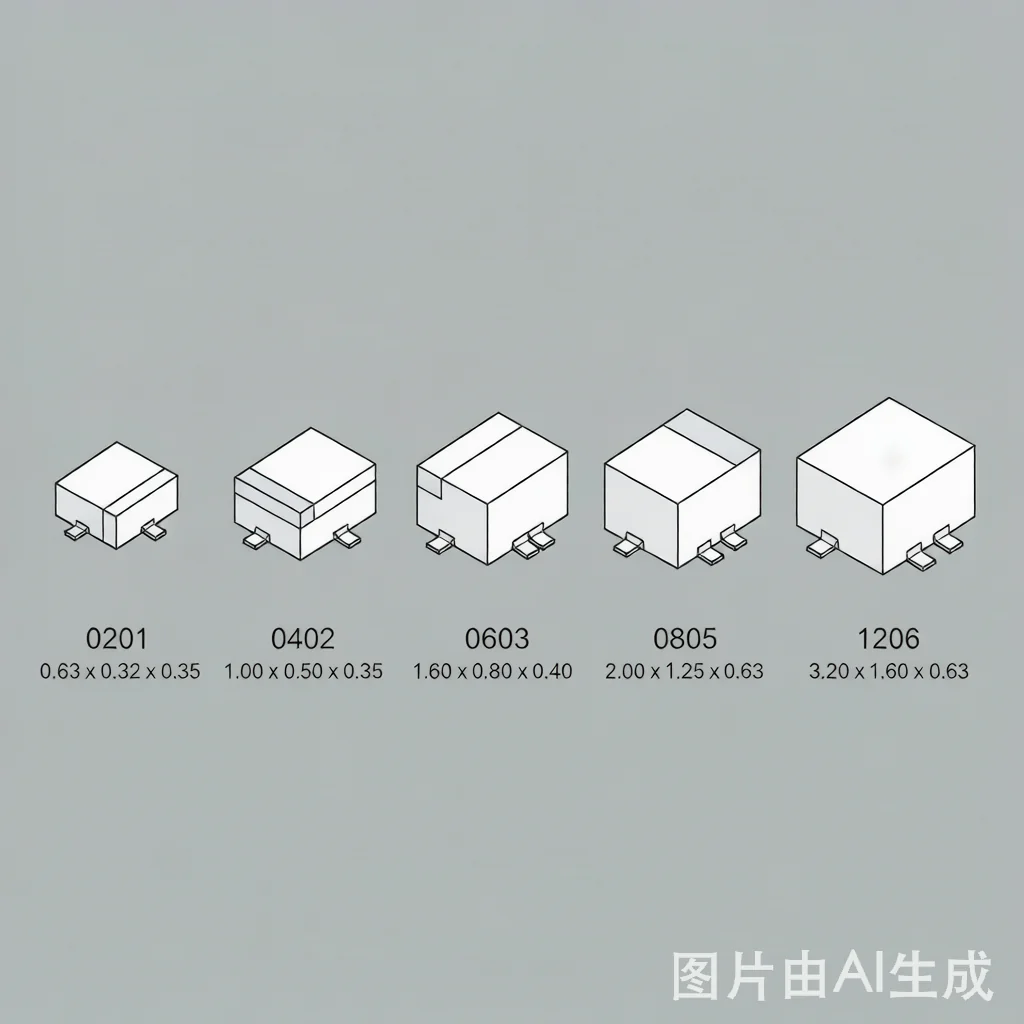
0402 vs 0603 vs 0805 MLCC: Package Size Selection Guide
Understanding MLCC Package Size Codes
MLCC package sizes are designated by a 4-digit code that follows the Electronic Industries Alliance (EIA) standard. The first two digits represent the length of the component in hundredths of an inch, and the last two digits represent the width in hundredths of an inch. For example, a 0603 package measures 0.06 inches (1.6mm) in length and 0.03 inches (0.8mm) in width. This standardized coding system allows designers and procurement professionals to communicate component requirements clearly across the global supply chain. It is worth noting that there is also a metric code system (such as 1608 for 0603), but the EIA inch-based code remains dominant in North American and European markets. When sourcing MLCC, always confirm whether the specification uses EIA or metric codes to avoid ordering incorrect parts.
Common MLCC Package Sizes and Their Applications
The most widely used MLCC package sizes range from 0201 (the smallest commonly available) to 2220 (used for high-voltage and high-capacitance applications). Each size offers different trade-offs in terms of capacitance range, voltage rating, PCB space consumption, and assembly difficulty. The 0201 package (0.6mm × 0.3mm) is typically used in space-constrained mobile devices and wearables. However, its maximum capacitance is limited (typically up to 0.1µF for X7R at 6.3V) due to the physical constraints on the number of ceramic layers that can fit inside the tiny body. The 0402 package (1.0mm × 0.5mm) represents a good balance between size and capacitance density, offering up to 0.1µF-1µF for X7R/X5R dielectrics. This size is widely used in smartphones, tablets, and increasingly in AI server motherboards where PCB real estate is at a premium.
- 0201 (0.6mm × 0.3mm): Maximum capacitance ~0.1µF (X7R, 6.3V). Used in mobile, wearables, SSD.
- 0402 (1.0mm × 0.5mm): Maximum capacitance ~1µF (X7R, 6.3V). Used in mobile, IoT, AI servers.
- 0603 (1.6mm × 0.8mm): Maximum capacitance ~10µF (X7R, 6.3V). Most common general-purpose size.
- 0805 (2.0mm × 1.25mm): Maximum capacitance ~47µF (X7R, 6.3V). Used for power decoupling.
- 1206 (3.2mm × 1.6mm): Maximum capacitance ~100µF (X7R, 6.3V). High-current power rails.
Capacitance and Voltage Limits by Package Size
The physical volume of the MLCC package directly limits the maximum capacitance and voltage rating. Higher capacitance requires more ceramic dielectric layers, which in turn requires more physical volume. Similarly, higher voltage ratings require thicker dielectric layers between plates, reducing the number of layers that can fit. As a result, smaller packages have both lower capacitance ceilings and lower maximum voltage ratings. For example, a 0201 MLCC is typically limited to 6.3V-10V rating, while a 1206 package can accommodate ratings up to 250V or higher in some cases. When selecting MLCC, always check the manufacturer's product matrix to confirm the available capacitance-voltage combinations for each package size. Exceeding the physical limits will result in the supplier proposing a larger package size or suggesting a different dielectric formulation.
PCB Assembly Considerations
Beyond electrical parameters, PCB assembly capabilities play a critical role in package size selection. Placing and soldering MLCC smaller than 0402 requires advanced pick-and-place equipment and reflow profiling. The 0201 and smaller 01005 packages have higher placement error rates and are more susceptible to tombstoning (where one end of the component lifts during reflow due to uneven solder paste melting). For high-volume production, designing with 0402 or larger packages can improve yield and reduce rework costs. Additionally, PCB trace routing becomes more challenging with smaller packages, as the pad pitch decreases. High-density interconnect (HDI) PCBs with microvias may be required for 0201 and 01005 designs, adding to the PCB cost. Procurement professionals should coordinate with their PCB assembly house early in the design phase to confirm the minimum capable package size.
Parameter Summary: Package Size Comparison Table
| Package | Dimensions (mm) | Max Capacitance (X7R, 6.3V) | Max Voltage (Typical) | Typical Applications |
|---|---|---|---|---|
| 0201 | 0.6 × 0.3 | 0.1µF | 10V | Mobile, Wearables, SSD |
| 0402 | 1.0 × 0.5 | 1µF | 25V | Mobile, IoT, AI Servers |
| 0603 | 1.6 × 0.8 | 10µF | 50V | General Purpose, Consumer |
| 0805 | 2.0 × 1.25 | 47µF | 100V | Power Decoupling, Industrial |
| 1206 | 3.2 × 1.6 | 100µF | 250V | High-Current Power, Automotive |
| 1210 | 3.2 × 2.5 | 100µF | 500V | Automotive, Industrial Power |
| 1812 | 4.5 × 3.2 | 100µF | 1kV | High-Voltage, Power Inverters |
Application Guidance for Package Size Selection
When selecting MLCC package size, consider the following hierarchy of priorities: (1) Electrical requirements (capacitance, voltage, temperature) — these set the minimum package size; (2) PCB space constraints — these may force smaller packages or require design trade-offs; (3) Assembly capabilities — ensure your PCB assembler can handle the selected package size with acceptable yield; (4) Cost — smaller packages are not always cheaper when accounting for assembly yield loss. For AI server and high-performance computing applications, the trend is toward 0402 and 0201 for high-speed power delivery where low ESL is critical. For automotive and industrial applications, 0603 and 0805 remain popular due to their robustness and ease of inspection. For cost-sensitive consumer electronics, 0402 and 0603 offer the best balance. AIMLCC can provide guidance on package size selection based on your specific application requirements and volume projections.
FAQ: MLCC Package Size Selection
Q1: Can I use a 0402 MLCC where the BOM specifies 0603?
A: Possibly, but several factors must be considered. First, confirm that the electrical parameters (capacitance, voltage, dielectric) are available in 0402 package with the same or better specifications. Second, verify that the PCB footprint is compatible or can be modified. Third, check with your assembly house that they can reliably place 0402 components. Finally, evaluate the risk of tombstoning and thermal cycling reliability. In many cases, downsizing from 0603 to 0402 is feasible for non-critical decoupling, but always consult your design and manufacturing teams.
Q2: Why do some high-capacitance MLCC have the same capacitance but different package sizes?
A: Manufacturers may offer the same capacitance value in different package sizes to provide options for customers with different space constraints. A 10µF X7R MLCC in 0603 package will have similar electrical characteristics to one in 0805 package, but the 0805 part may have lower ESR and ESL due to its larger physical size allowing for better internal electrode design. Additionally, the 0805 part may have better voltage derating characteristics. When both are available, choose based on your PCB space and electrical performance requirements.
Q3: How does package size affect MLCC reliability in automotive applications?
A: Smaller packages (0201, 0402) are more susceptible to cracking due to PCB flexure and thermal cycling stress. For automotive applications, especially those with expected PCB flexure (such as in engine compartment ECUs), it is recommended to use 0603 or larger packages, or specify soft termination MLCC that can withstand flexure without cracking. AIMLCC can assist with sourcing automotive-grade MLCC with appropriate package sizes and soft termination options.
RFQ Checklist for MLCC Package Size
- Specify required package size (or indicate if flexible)
- Confirm PCB footprint compatibility if substituting package size
- State assembly house capabilities (minimum capable package size)
- Indicate whether AEC-Q200 or other reliability standards are required
- Mention if soft termination is needed (for automotive/high-reliability)
- Provide quantity and delivery schedule requirements
How to Source MLCC by Package Size Through AIMLCC
AIMLCC is an independent sourcing platform that can procure MLCC in all standard EIA package sizes, from 0201 to 2220 and beyond. When submitting your RFQ, clearly specify the required package size or indicate if alternatives are acceptable. Our global supplier network includes sources for both common package sizes (0603, 0805) and harder-to-find smaller packages (0201, 01005) that may have longer lead times. We can also assist with package size conversion analysis—evaluating whether a BOM specified with 0603 packages can be converted to 0402 to save PCB space, or whether reliability concerns warrant upsizing to 0805. Use our BOM upload tool to get a comprehensive package size optimization review along with stock check and cross-reference suggestions.