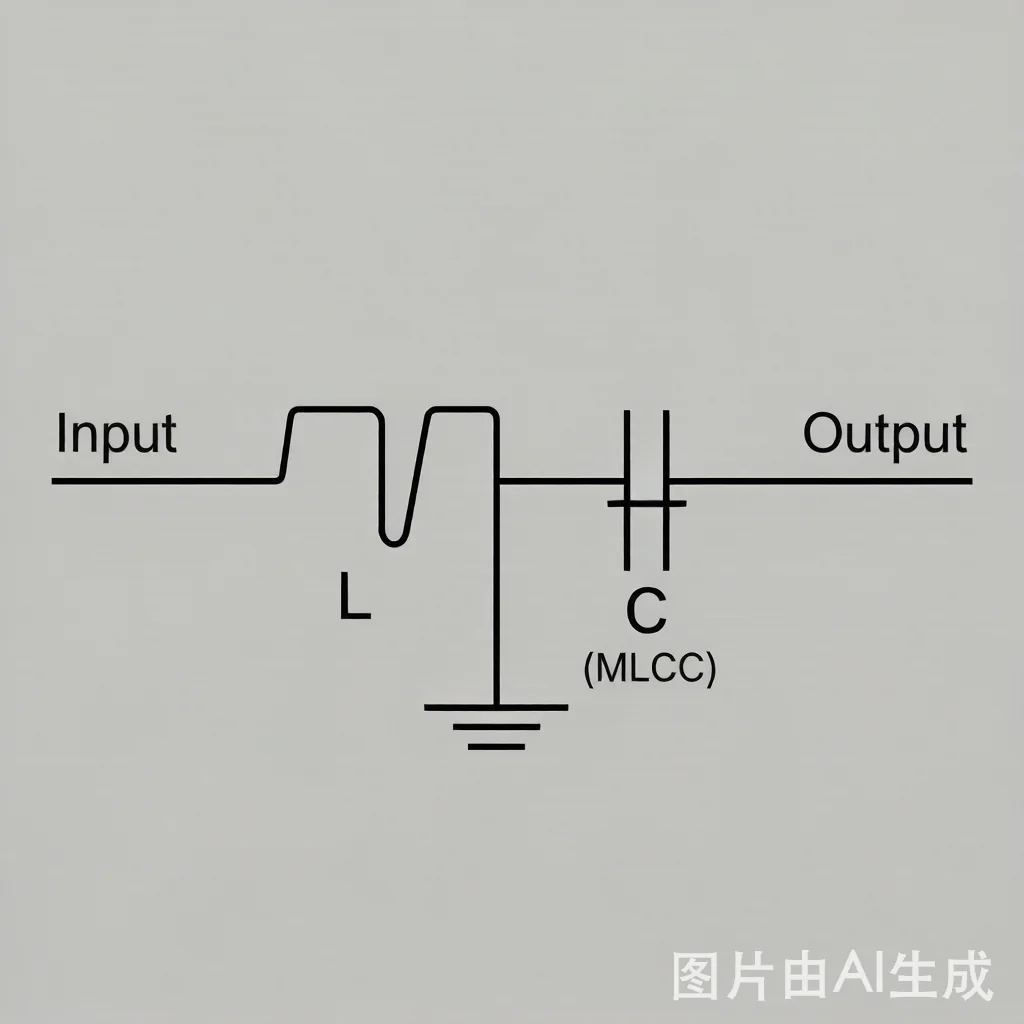
Radio frequency and microwave circuits demand capacitors with exceptional stability, low loss, and predictable behavior across frequency and temperature. C0G (NP0) dielectric MLCCs are the preferred choice for these applications because they offer a zero temperature coefficient, no DC bias derating, no aging, and high quality factor (Q). This guide covers the sourcing considerations for RF high-Q C0G/NP0 MLCCs from Johanson, AVX, TDK, Murata, and Walsin, with specific attention to case size selection, frequency performance, and RFQ specification.
C0G (Class 0, General purpose), also known as NP0 (Negative-Positive-Zero), is a Class I ceramic dielectric with a temperature coefficient of 0 plus or minus 30 ppm per degree Celsius over the full operating range of -55C to +125C. Unlike Class II dielectrics (X7R, X5R, X6S), C0G exhibits no ferroelectric behavior, which means:
These characteristics make C0G MLCCs indispensable for RF high-Q MLCC applications where capacitance stability directly affects frequency accuracy, filter bandwidth, and impedance match quality.
In RF circuits, the quality factor (Q) of a capacitor determines how much signal power is dissipated as heat. Q is inversely proportional to the equivalent series resistance (ESR) and dissipation factor (tan delta). High-Q C0G MLCCs are engineered with optimized electrode materials and termination designs to minimize ESR at RF frequencies, achieving Q values above 1000 at 1MHz for small capacitance values.
The self-resonant frequency (SRF) is the frequency at which the capacitor's parasitic inductance causes it to behave as an inductor rather than a capacitor. Above SRF, the component cannot function as a capacitor. SRF is primarily determined by capacitance value and package parasitic inductance:
For matching networks operating at 2.4 GHz, 5 GHz, or higher, 0201 and 0402 case sizes are strongly preferred. The 0603 case size is suitable for sub-GHz RF applications, IF filters, and oscillator circuits where SRF requirements are less demanding.
RF applications span a wide range of capacitance values depending on the circuit function:
The availability of high capacitance values in C0G has expanded significantly in recent years. C0G 2.2uF in 0402 case size, once impractical, is now sourced for applications where the combination of high capacitance and zero derating provides design advantages over X7R alternatives.
| Parameter | 0201 C0G | 0402 C0G | 0603 C0G | 0805 C0G |
|---|---|---|---|---|
| Capacitance Range | 0.1pF to 100pF | 0.1pF to 2.2uF | 0.1pF to 1uF | 0.1pF to 1nF |
| Voltage Range | 16V to 25V | 16V to 50V | 16V to 100V | 25V to 100V |
| Temperature Coefficient | 0 plus or minus 30 ppm/C | 0 plus or minus 30 ppm/C | 0 plus or minus 30 ppm/C | 0 plus or minus 30 ppm/C |
| Dissipation Factor | less than 0.1% | less than 0.1% | less than 0.1% | less than 0.1% |
| Typical Q at 1MHz | 1000+ | 1000+ | 800+ | 500+ |
| Parasitic Inductance | ~0.3nH | ~0.4nH | ~0.5nH | ~0.7nH |
| Application | Frequency Range | Case Size | Typical Capacitance | Key Parameter |
|---|---|---|---|---|
| 5G mmWave matching | 24 GHz to 40 GHz | 0201 | 100pF | SRF above 20 GHz |
| WiFi/Bluetooth match | 2.4 GHz to 5 GHz | 0201, 0402 | 100pF to 1nF | Q factor, tolerance |
| RF PA bias decoupling | DC to 6 GHz | 0603 | 1uF | No DC bias derating |
| Oscillator load cap | 16 MHz to 48 MHz | 0603 | 10pF to 22pF | Temperature stability |
| IF filter coupling | 100 MHz to 1 GHz | 0402, 0603 | 1nF | Low loss tangent |
| DC block in RF path | DC to 10 GHz | 0402 | 100pF | SRF, ESR |
The following RF high-Q C0G MLCC part numbers are available for sourcing inquiry. Click any part number to view detailed specifications:
For more RF-grade MLCC options, visit the Johanson, AVX, TDK, Murata, and Walsin brand pages, or upload your BOM for batch sourcing of RF components.
Submit your RFQ through the MLCC RFQ form for independent sourcing support. Use the cross-reference tool to find equivalent C0G RF MLCCs across Johanson, AVX, TDK, Murata, and Walsin. For RF-specific application guidance, see MLCC for 5G RF modules.
A: High-Q RF C0G MLCCs are specifically engineered for RF applications with optimized electrode designs, low-loss termination materials, and tighter Q factor control. While both use C0G dielectric, RF-grade parts typically have higher Q values at RF frequencies, more precise tolerance options, and better characterized SRF and ESR performance. Johanson and AVX specialize in RF-grade C0G MLCCs, while Murata GCM and TDK CH series also offer C0G options suitable for many RF applications.
A: It depends on the capacitance value. The self-resonant frequency of a 0603 C0G MLCC with 1nF capacitance is typically around 1 to 2 GHz, which is below 5 GHz. For 5 GHz applications, use 0201 or 0402 case sizes with capacitance values of 100pF or less to ensure the SRF is well above the operating frequency. Always check the SRF specification in the datasheet or request it via RFQ.
A: X7R dielectric exhibits capacitance variation with DC bias, temperature, and time, which can affect the impedance of the bias decoupling network under varying operating conditions. C0G 1uF provides stable capacitance regardless of bias voltage or temperature, ensuring consistent PA bias line impedance. Additionally, C0G has no piezoelectric effect, preventing microphonic noise from affecting PA performance. The trade-off is that C0G 1uF in 0603 may be more expensive and less readily available than X7R alternatives.
A: RF matching networks typically require 1% or 2% tolerance capacitors to maintain impedance match accuracy. Standard C0G MLCCs are available with 0.1pF, 0.25pF, 0.5pF, 1%, 2%, and 5% tolerance grades. For matching networks at 2.4 GHz and above, 1% or tighter is recommended. For coupling and bypass applications where exact capacitance is less critical, 5% tolerance may be acceptable. Specify the required tolerance in the RFQ.
A: In many cases, yes, if the case size, capacitance, voltage, and tolerance match. However, RF-grade parts from Johanson and AVX may have different Q factor, SRF, and ESR characteristics compared to general-purpose C0G parts from Murata or TDK. For critical RF matching applications, verify Q factor and SRF specifications through datasheets or RFQ confirmation before approving cross-brand substitutions. Use the cross-reference tool to identify candidate equivalents.
AIMLCC will check current stock, lead time and alternatives based on your part numbers or BOM.

Quick RFQ