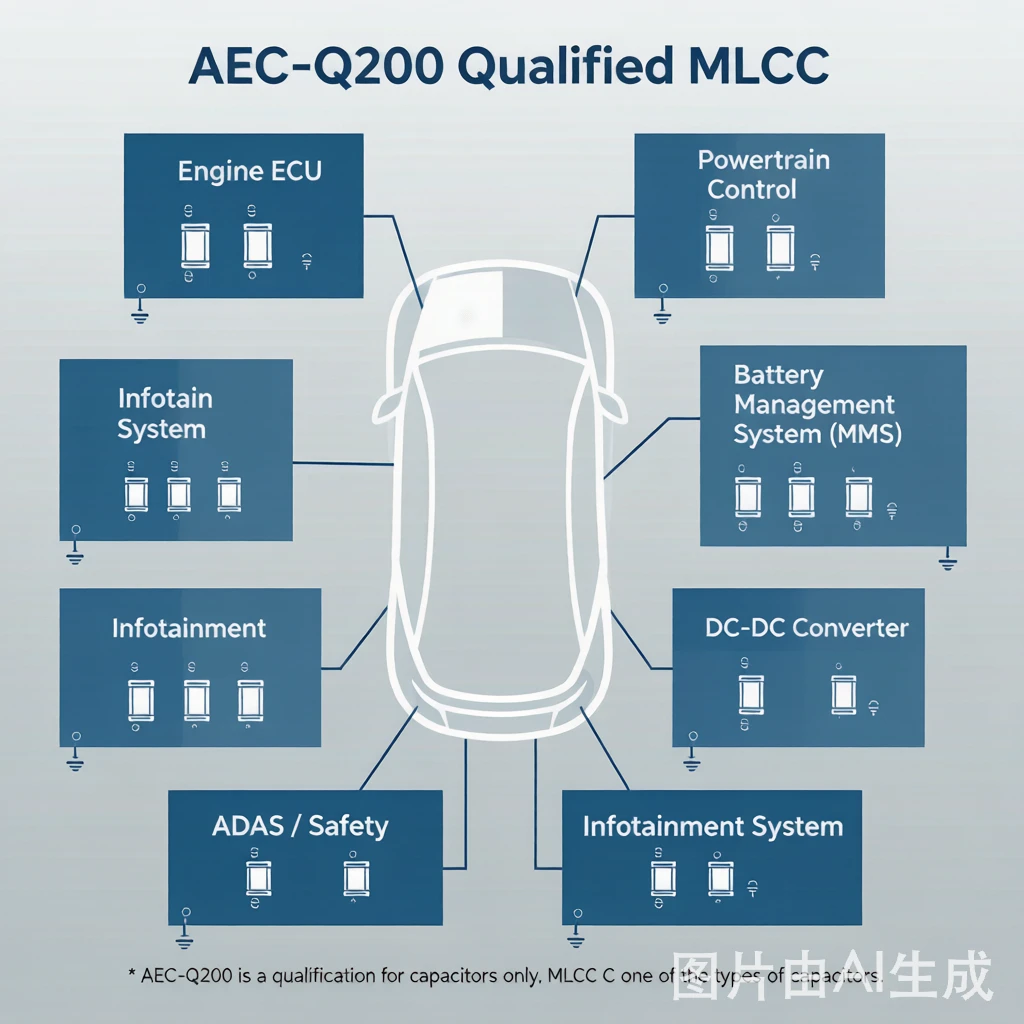
TDK Corporation is a leading supplier of electronic components, including a comprehensive range of multilayer ceramic capacitors (MLCCs). TDK's C series and CGA series MLCCs are widely specified in automotive, industrial, and high-reliability applications. This selection guide covers the key differences between C and CGA series, parameter comparisons, and sourcing considerations for automotive and industrial designs.
TDK organizes its MLCC products into several series, each targeting specific application segments:
For automotive and industrial designs, the C series and CGA series are the primary options. TDK MLCC products are recognized for their reliability and are widely adopted in automotive electronics, industrial automation, and power electronics.
The primary difference between TDK C series and CGA series MLCCs is the qualification level and target application. CGA series parts undergo additional testing and qualification to meet automotive industry standards.
| Feature | C Series | CGA Series |
|---|---|---|
| AEC-Q200 Qualified | No | Yes (Rev D/E) |
| Operating Temperature | -55°C to +125°C | -55°C to +150°C |
| Reliability Testing | Standard | Enhanced (automotive protocol) |
| PPAP Documentation | Not available | Available upon request |
| Target Application | Consumer, industrial | Automotive, high-reliability industrial |
| Case Size Range | 0201 to 1210+ | 0402 to 1210 |
| Voltage Rating | 6.3V to 1000V | 16V to 1000V |
Automotive electronics require components that can withstand harsh operating conditions including wide temperature ranges, vibration, moisture, and thermal cycling. AEC-Q200 qualification is the industry standard for passive components used in automotive applications.
TDK CGA series MLCCs are qualified to AEC-Q200 standards, which include rigorous testing protocols:
For automotive-grade MLCC sourcing, specifying CGA series parts ensures compliance with automotive industry requirements. Automotive electronics applications span from infotainment systems to advanced driver assistance systems (ADAS).
TDK C and CGA series MLCCs are available in standard EIA case sizes. The selection of case size and dielectric depends on the application requirements:
For automotive and industrial designs, dielectric selection should consider the operating temperature range and required capacitance stability:
For AEC-Q200 MLCC applications, X7R and C0G dielectrics are most commonly specified due to their temperature stability.
| Parameter | C Series (0201) | C Series (0603) | CGA Series (0603) | CGA Series (1206) |
|---|---|---|---|---|
| Capacitance (C0G) | 0.1pF to 100pF | 0.1pF to 10nF | 0.1pF to 10nF | 0.1pF to 47nF |
| Capacitance (X7R) | 100pF to 10nF | 100pF to 1uF | 100pF to 1uF | 1nF to 10uF |
| Voltage Rating | 6.3V to 50V | 6.3V to 100V | 16V to 100V | 16V to 100V |
| Thickness (max) | 0.33mm | 0.85mm | 0.85mm | 1.6mm |
| AEC-Q200 | No | No | Yes | Yes |
| Operating Temp | -55°C to +125°C | -55°C to +125°C | -55°C to +150°C | -55°C to +150°C |
| Application | Series | Case Size | Dielectric | Voltage Rating |
|---|---|---|---|---|
| Engine control unit (ECU) | CGA | 0603, 0805 | X7R, C0G | 25V to 100V |
| Infotainment system | CGA | 0402, 0603 | X7R, X5R | 6.3V to 25V |
| ADAS processing | CGA | 0603, 0805 | X7R, C0G | 16V to 50V |
| EV power inverter | CGA | 0805, 1206 | X7R | 25V to 100V |
| Industrial PLC | C, CGA | 0603, 0805 | X7R, C0G | 25V to 100V |
| Power supply | C, CGA | 0805, 1206 | X7R, X5R | 6.3V to 50V |
| RF communication module | C | 0201, 0402 | C0G | 25V to 250V |
For electric vehicle applications, CGA series MLCCs are essential due to the high-reliability requirements of EV power electronics and battery management systems.
The following TDK C series and CGA series MLCC part numbers are available for sourcing inquiry:
For additional TDK part numbers, browse the TDK MLCC catalog. To request sourcing support for specific part numbers, upload your BOM or submit an RFQ.
When selecting between TDK C series and CGA series, consider the following decision factors:
Submit your RFQ through the MLCC RFQ form. Independent sourcing support is available for TDK C and CGA series MLCCs.
A: While C series parts may function in automotive environments, AEC-Q200 qualified CGA series parts are strongly recommended for automotive applications to ensure reliability and compliance with industry standards. Using non-qualified parts in automotive applications may pose reliability risks.
A: The C series is the general-purpose MLCC line. The CH series (high-frequency) is optimized for RF applications with low ESR and excellent high-frequency characteristics. For RF and microwave applications, CH series or C0G dielectric C series parts are recommended.
A: AEC-Q200 qualified TDK MLCCs carry the "CGA" series designation. The part number will start with "CGA" followed by the case size code. Additionally, the datasheet and product labeling will indicate AEC-Q200 qualification.
A: Lead times vary based on part availability and market conditions. RFQ for current stock and lead time. Automotive-grade parts may have different lead times compared to commercial-grade equivalents.
A: Yes, TDK CGA series MLCCs are compatible with lead-free soldering processes. The termination materials are designed to withstand the higher temperatures associated with lead-free assembly. Refer to the datasheet for recommended reflow profiles.
AIMLCC will check current stock, lead time and alternatives based on your part numbers or BOM.
AIMLCC Sourcing Team
Last updated: 2026-06-28
AIMLCC Data Review
Product parameters reviewed from public manufacturer or distributor data.
MLCC part parameters referenced in this article are based on publicly available manufacturer datasheets, distributor product pages, and industry-standard specifications. For specific part verification, please visit the manufacturer product page or send an RFQ to AIMLCC for current stock, lead time, and sourcing support.

Quick RFQ